Most growth plans run on assumptions nobody has tested. I turned that observation into a working system: software that reads a business, diagnoses the strategy, and shows which belief the whole plan depends on. It is a worked example of how I think, made operational.
What it is
Strategy intelligence
My role
Architected & built
Status
Live, in testing
Stack
Python · Claude · Supabase
Every founder I have worked with makes the same category of mistake: they reason from a plan they are already attached to. The competitor set is the comfortable one, not the real one. The channel is the one that worked last time, not the one that fits this stage. The budget assumes the category will not be commoditised by the tools arriving this year. A good strategist catches these in a room. I wanted to know whether the catching could be made systematic, consistent, and fast enough to run on any business. So I built it.
01
A diagnosis layer, not a chatbot
The core is a multi-pass inspection modelled on how a seasoned CMO actually reasons. It reads a growth plan and surfaces the assumptions holding it up, then tests each one: is this the right-market competitor set, or the flattering one? Does the plan account for AI reshaping the category? Is the channel mix matched to the stage and the budget, or inherited? The output is not advice in prose. It is a structured verdict a founder can act on.
The hard constraint I set was consistency. The same intake has to produce the same verdict across runs, or the tool is just a mood. I built that in through fixed ranking rules rather than a cache, so the reasoning is repeatable without storing a client's details.
What this demonstrates
Turning tacit expert judgement into an explicit, testable process
Designing for repeatable verdicts, the difference between a tool and a toy
Encoding a point of view about strategy into software without it becoming generic
02
A plan that is actually implementable
Diagnosis is the easy half. The value is in what comes next, so the plan ranks every recommended action P1 or P2, attaches an impact score and an ROI estimate, and runs a cost-benefit on the positioning, messaging and brand changes so they stop being vibes and start being line items. The 4Ps and 7Ps run visibly across the whole analysis, so nothing important is quietly skipped. A founder with no strategist on staff can read it and know what to do first, and why.
The plan, ranked by return on effort. Every move is costed over ninety days, with the arithmetic shown and a test that says when to scale or stop.
03
A verifiable knowledge base of over 300 connected nodes
The part I am proudest of is the one nobody sees. Underneath the product sits a structured knowledge base I built and keep growing: over 300 connected nodes of mechanisms, frameworks, geographic playbooks and patterns of thinking the engine reasons from, each wired to the others so a conclusion can be traced back through the reasoning that produced it. It is the difference between an ungrounded chatbot and an instrument whose conclusions you can check. The method stays private; the fact that the intelligence is grounded and checkable is the point.
Knowledge base
300+ connected nodes
Built on
Tested marketing theory
Covers
Mechanisms · frameworks · geo playbooks
Every call
Traceable to a source
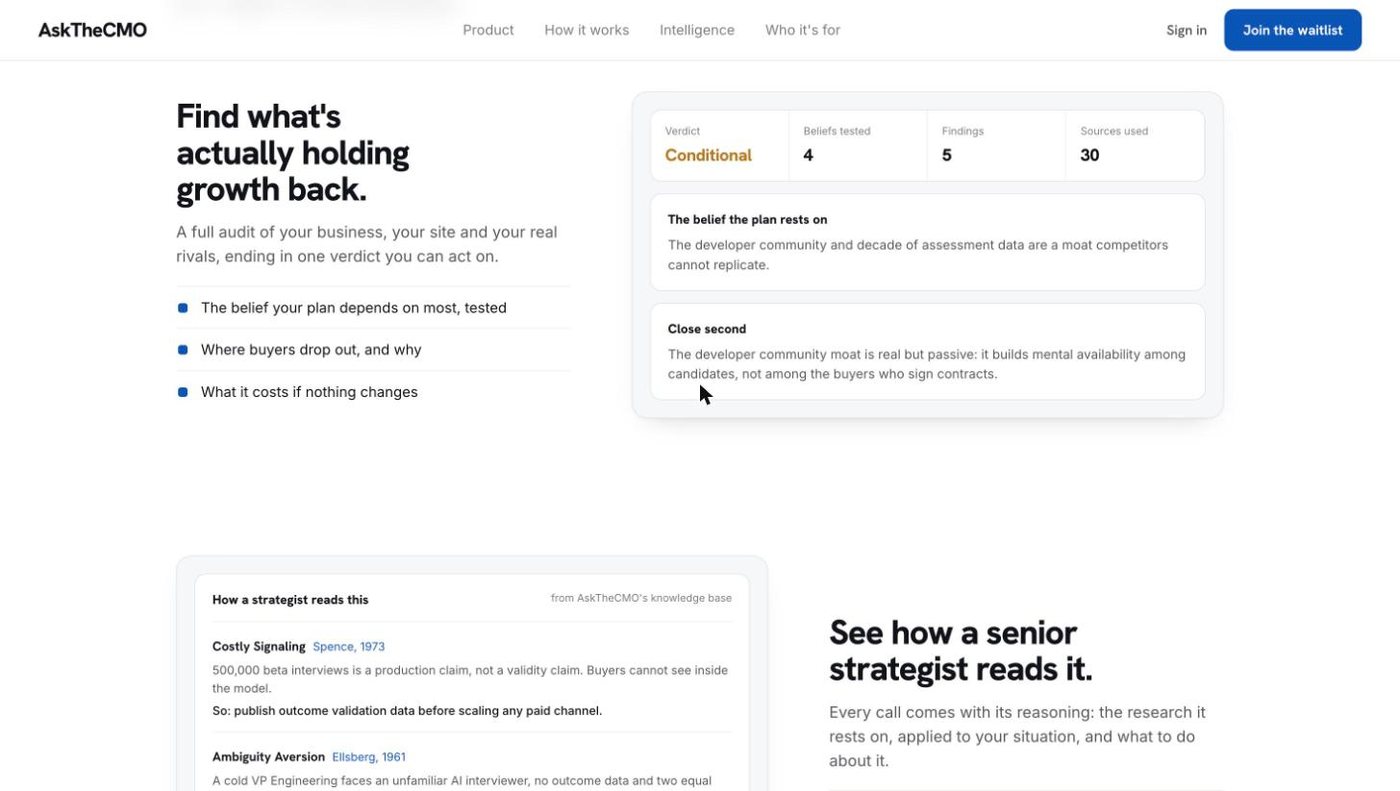
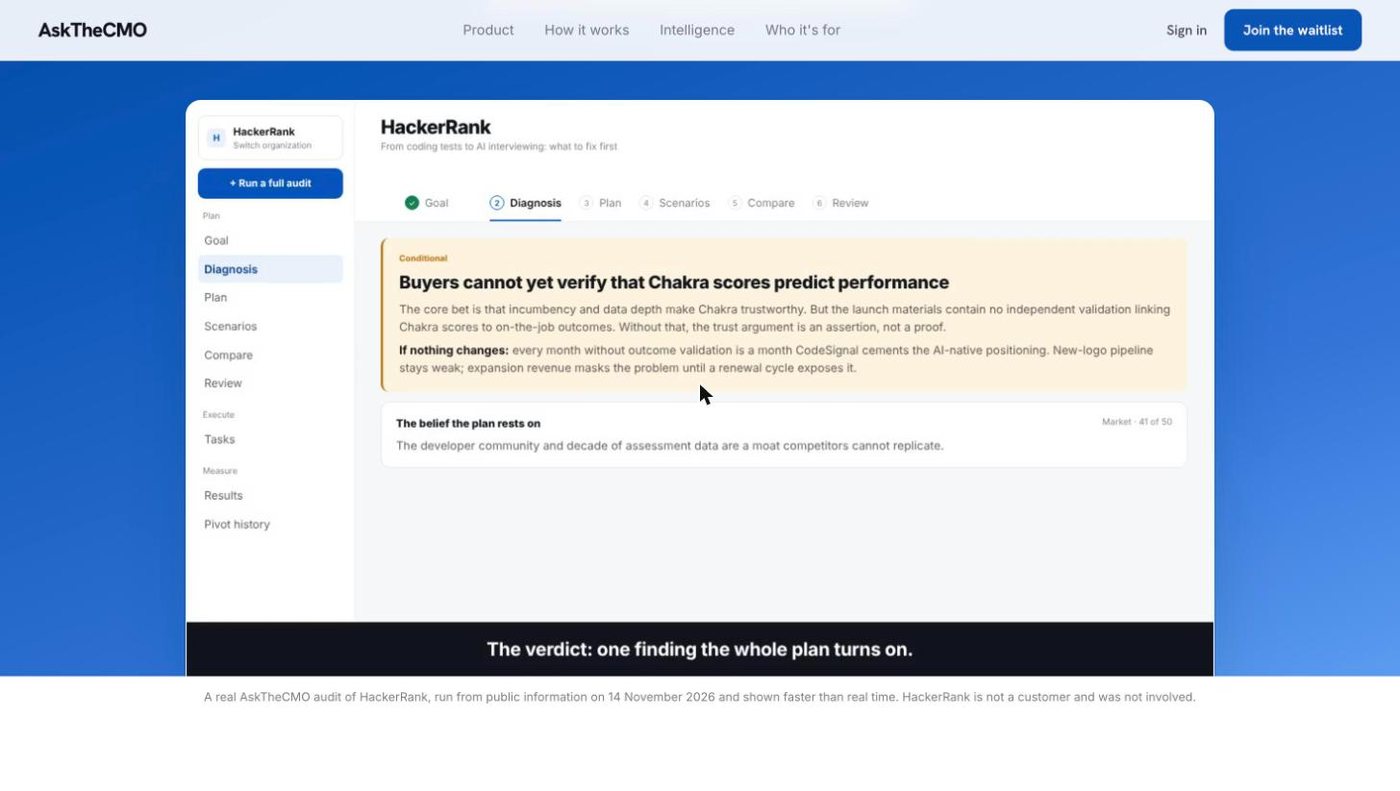
A real audit in the tool. One verdict, the belief the plan depends on, and the reasoning behind it.
04
Reasoning you can trace back to its source
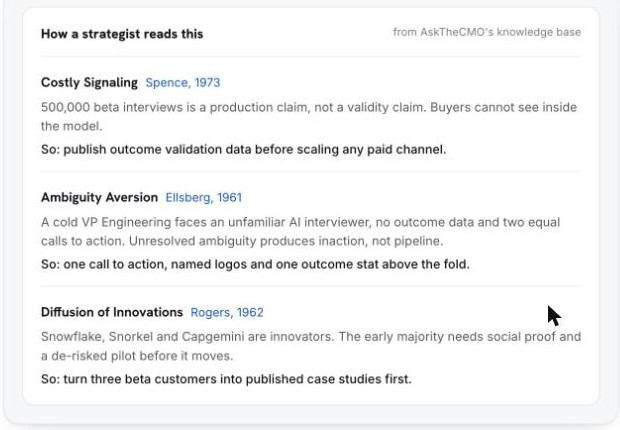
Every finding carries its reasoning. The engine shows which tested idea a conclusion rests on and which sources it drew from, down to the specific theory behind a recommendation. The point is traceability: a verdict a founder can interrogate, not a confident paragraph they have to take on faith.
How a strategist reads it. Each call names the research it rests on, from Spence 1973 to Rogers 1962, with one clear instruction after every point.
See it live
The product and its positioning are public. The underlying method stays private.